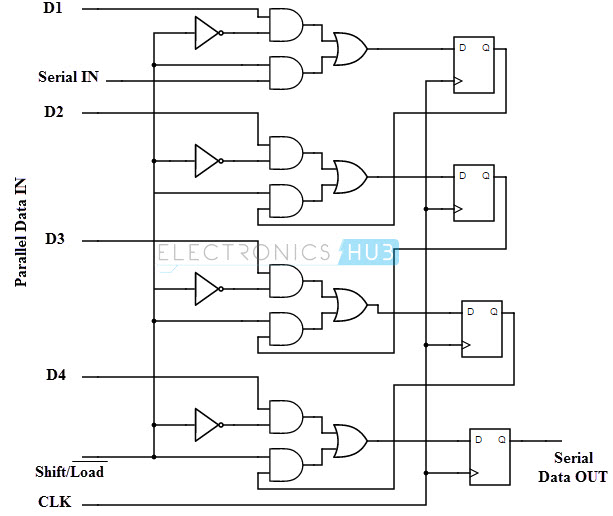
Jun 19, 2012 Design a 2's complementer with a shift register and a flip-flop. The binary # is shifted out from one side and it's 2's complement shifted into the other side of the shift register. Design a 2's complementer with a shift register and a flip-flop. The binary # is shifted out from one side and it's 2's complement shifted into the other side of the shift register.
Thanks for your kind reply See I have followed you and understood your line 39 to 51 is printable characters. In my case I have attached 74HC165 TO GET PARALLEL DISPLAY DATA FROM AN INSTRUMENT TO CONVERT IT INTO SERIAL AND THEREAFTER SERIAL DATA INPUT TO ARDUINO FOR DISPLAYING THE OBJECT OF THE INSTRUMENT INTO THE DISPLAY OF ARDUINO. AND THERE IS MY PROBLEM IN SPTE OF GETTING THE “INSTRUMENTAL DISPLAY OBJECT” i AM GETTING THE “011000” VALUE ACCORDING TO YOURS. WOULD YOU PLEASE BE ABLE TO GUIDE ME TO CONVERT THIS “011000” DATA TO ACTUAL DISPLAYING OBJECT? THANKS FOR YOUR INFORMATION: THE ACTUAL DISPLAY OF THIS INSTRUMENT HAS BEEN DISCONTINUED AND THEREFORE i WANT TO TAKE THE DISPLAY DATA OF THE INSTRUMENT INTO ARDUINO THROUGH ON ITS LCD. From my understanding, you have the buttons well connected to the shift register and the output of shift register is also connected to the Arduino. If you are using the same display (16×2 HD44780 LCD), then the code above should have worked for you.
If you are using other display, you may need to change to code for the display. Another thing that you can try is, first make sure you read what is exactly send from the shift register. Change the code to display it using your serial monitor. From there, if you able to read the correct input from your buttons, then its just the display code you need to work on. Hope this helps.
Just to be fair, this is a previous exam question and was an assignment question. I've already handed in the assignment and now I'm trying to see why I got it wrong -- to study for my final. I fully understand how to find the 2's complement of a binary number, however, implementing a circuit to find the complement is driving me crazy. I'm given a shift register (that stores my binary number) and a flip flop (using D for simplicity). The process I follow for building sequential circuits is this: • I look at the question and derive a state diagram. • From the state diagram, I draw a state table and find the input of my flip flops • I use maps and stuff to finally build the circuit. I'm trying to visualize how to actually draw the state diagram for this complementer.
Internal medicine essentials for clerkship students pdf program. I know it depends on the previous value and stuff, but if someone could take the time to explain in plain english how he/she would go about building the state diagram, I would be vey grateful. That link you gave says it all: Hint: - 2’s complement of a number can be obtained by keeping the least significant bits as such until the first 1, and then complementing all bits 'example 001010 → 110110' that is to say 001010 -> flip bits -> 110101 -> add 1 -> 110110 msb lsb msb lsb msb lsb msb lsb input 001010 output 110110.